What is Rapido?
Rapido is Velrada's data platform accelerator for Microsoft Fabric. It provides reusable patterns for bringing data from different source systems into a structured, analytics-ready data platform.
With Rapido, supported data sources and objects can be configured using metadata instead of creating a separate pipeline for every table or source. This provides a consistent approach to data ingestion, transformation and operational management.
What can you use Rapido for?
You can use Rapido to:
Ingest data from supported source systems
Organise data through Landing, Bronze, Silver and Gold layers
Configure supported ingestion and transformation patterns using metadata
Apply data quality checks
Reconcile data as it moves through the platform
Monitor data processing and failures
Restart supported processing after a failure
Prepare business-ready data for Power BI and other analytics use cases
Supported data sources
Rapido provides patterns for:
SQL databases
REST APIs
Business Central
FinOps
Dataverse
REST API support includes GET and POST requests, paging and parent-child calls.
When a new object uses an existing supported pattern, onboarding primarily involves configuration, connection setup and validation.
New source types, authentication methods, connector behaviours or business rules may require additional engineering.
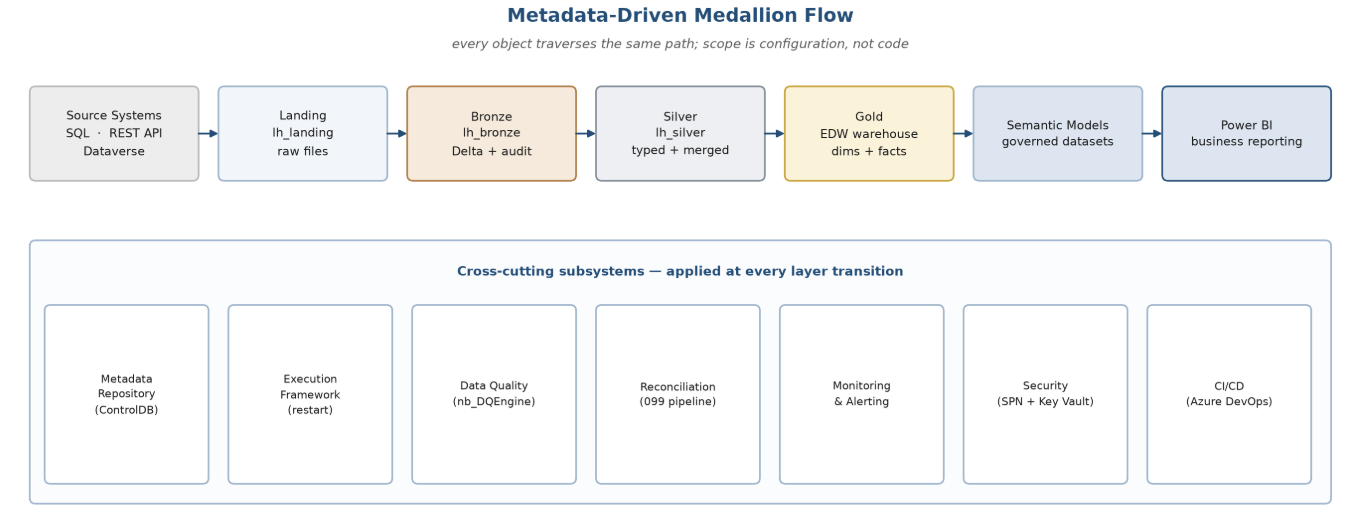
How data moves through Rapido
Data progresses through four layers:
Landing → Bronze → Silver → Gold
Landing stores data received from the source system.
Bronze standardises the data and adds processing information.
Silver cleans and conforms the data.
Gold provides business-ready dimensions and facts for reporting and analytics.
Built on Microsoft
Technology | How it is used |
|---|---|
Microsoft Fabric | Runs pipelines, notebooks, lakehouses, warehouses, SQL databases and reports |
OneLake | Stores Landing, Bronze and Silver data |
Fabric Warehouse | Stores Gold dimensions and facts |
Fabric SQL Database | Stores Rapido configuration and operational records |
Power BI | Provides semantic models and operational reporting |
Variable Library | Manages environment-specific settings |
Azure Key Vault | Stores secrets used by custom runtime code |
Azure DevOps | Provides Git source control and supports the release process |