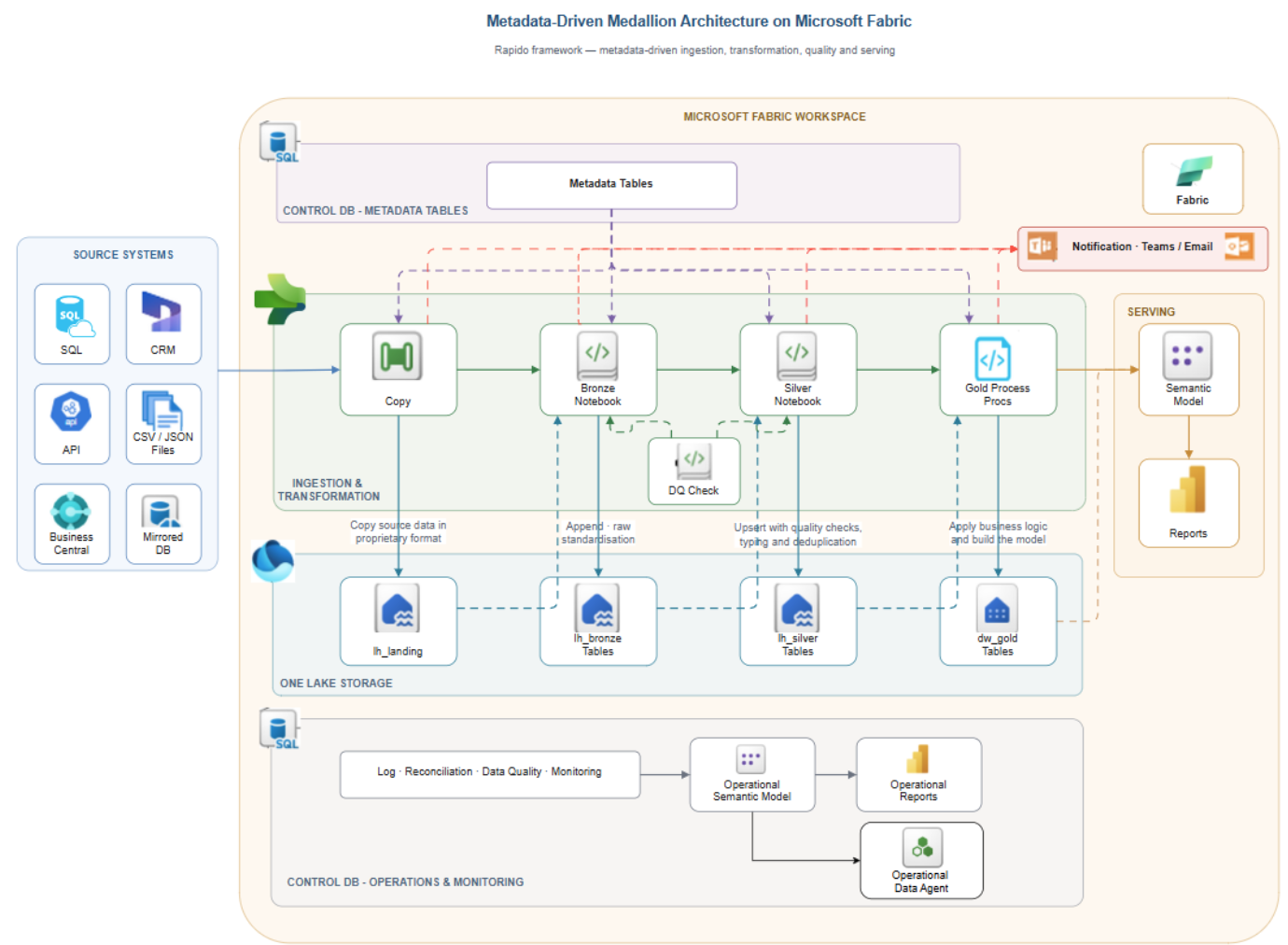
Rapido uses a medallion architecture to organise data as it moves from a source system to business-ready information.
The architecture consists of four layers:
Landing → Bronze → Silver → Gold
Each layer has a specific purpose and represents a stage in the data processing journey.
Landing
Landing is the first destination for data extracted from a source.
Source extracts are stored in formats such as:
Parquet
JSON
CSV
Data is organised by source, object and load date.
At this stage, the objective is to retain a record of the data received from the source before downstream processing changes its structure.
Bronze
Bronze converts incoming data into standardised Delta tables.
Rapido adds execution and ingestion audit information during this stage so records can be associated with the load that delivered them.
Supported processing can also include JSON flattening and additive schema handling.
Silver
Silver creates clean, conformed, current-state data ready for modelling.
Depending on the configured processing pattern, this can include:
Mapping columns
Changing data types
Renaming columns
Standardising dates
Standardising time zones
Applying keyed Type 1 merges
Gold
Gold contains business-ready dimensions and facts in Fabric Warehouse.
Gold objects can have dependencies. Rapido processes these in dependency groups so required dimensions can complete before facts that rely on them.
Business logic can be defined using supported metadata or approved stored procedures.
Gold data can then be used by governed semantic models and Power BI reporting.
How configuration drives processing
Rapido uses a Fabric SQL Database called ControlDB to store configuration and operational information.
ControlDB can contain:
Layer configuration
Column mappings
Gold targets
Alert settings
Data quality rules
Reconciliation mappings
Execution tracking
Operational logs
Rapido's shared pipelines and notebooks read this configuration and apply the supported processing pattern.
This allows supported changes to be made through configuration without creating a separate implementation for every data object.
Important: Not every requirement is configuration-only. New connector behaviour, transformation patterns, authentication methods or business rules may require engineering assessment.